Everest Lightning Ascent – How we developed the fastest way to climb Everest
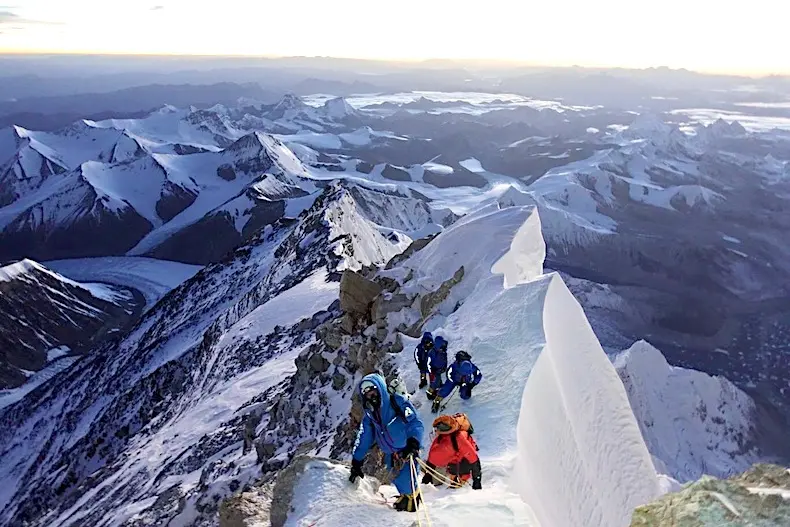
We’ve been building and refining Rapid Ascent™ for fifteen years. For Alpenglow Expeditions, Lightning Ascent is a clear next progression from that system.
I still believe Rapid Ascent™ is the single best, safest, most enjoyable way to climb Everest, and we’re going to keep promoting it, keep recommending it, and keep tweaking it as the technology and the team around it change.
But for as long as we’ve offered Rapid Ascent™, one thing has stayed true: even a thirty-six-day expedition is more time away from family, friends, and work than some people can give. That gap is what Lightning Ascent exists to close.
How long does it take to climb Mount Everest?
A standard Mount Everest expedition takes 60 to 75 days, or roughly two to two and a half months. Alpenglow’s Rapid Ascent™ itinerary takes 36 days, and our Lightning Ascent expedition takes just 15 days. For the full breakdown, see our guide to how long it takes to climb Mount Everest.
Standard expeditions take two months because our bodies need weeks to adjust to the extreme altitudes where we’re camping, sleeping, or climbing through acclimatization rotations. We shortened the expedition time by almost half using pre-acclimatization and our Rapid Ascent™ methodology. Our teams sleep in hypoxic tents for weeks before the expedition, so they arrive already acclimatized. Our goal with a 36-day itinerary is to keep all the necessary acclimatization and training, but to minimize the unnecessary waiting of traditional expeditions.
Now, even shorter, 15-day expeditions are possible, and Alpenglow Expeditions was the first company to successfully complete one. Here’s how.
Proving it was possible
We saw the first hint of what was possible back in 2019, when Alpenglow became the first to run a true fourteen-day, USA-to-USA Everest summit. The climber on that trip was a semi-professional athlete who could dedicate two full years of training and performance prep to the attempt. It worked. And it told us that Everest can be climbed in two weeks.
That trip told us it is possible to climb Everest even more quickly, and with a lower risk profile.
A single, continuous push towards the summit
For the first time, three things have converged enough to let a team move up Everest in a single push, with no acclimatization rotations at all: the best available weather forecasting and supplemental-oxygen systems, and the pre-acclimatization work Rapid Ascent™ already requires before a climber ever leaves home.
Rotations exist to let the body slowly adapt on the mountain. Remove the need for that adaptation on-site, and you remove the single biggest reason that an Everest expedition has ever needed to take so long.
What that looks like on the mountain
Lightning Ascent climbers arrive once camps and fixed ropes are already established up to, or close to, the summit. Climbing the north side means we can move fast, getting there by driving straight across the Tibetan Plateau to base camp instead of depending on helicopters and the weather windows they require. From base camp, climbers move up through Alpenglow’s own system of comfortable camps, real food, an unlimited oxygen supply, and medical support led by Monica Pieris, one of the most experienced high-altitude expedition doctors working today. The climb happens day by day, with rest days built in where they’re needed, but without the multi-week rotations that have defined every Everest expedition before this one.
What doesn’t change
Faster doesn’t mean easier, and it doesn’t mean less qualified. Lightning Ascent doesn’t lower our experience requirements; the prerequisites are exactly what they’ve always been for our Everest teams. The days are still hard. Safety still comes first, ahead of the schedule, every time. The mountain remains the mountain: weather, avalanche conditions, and route safety can still force us to adjust, and if a team member’s health or the conditions don’t cooperate, the plan extends. Two weeks is the goal Lightning Ascent is built around, with the flexibility to adapt to what the mountain throws at us.
This has been years in the making: Rapid Ascent’s own fifteen-year refinement, plus a long run of private expeditions where we tested new systems and questioned assumptions about what an Everest climb actually requires. We’re finally ready to bring that work to the general public.
Join us in 2027 for Alpenglow Expeditions’ Lightning Ascent.